Showing posts with label b&w. Show all posts

9.16.2014

The trouble with Garry...

During my undergrad studies in photography (as in many photography programs across the nation), many professors site Garry Winogrand's work, and many students aspire to emulate his style...and rightfully so...


But there was always something about Winogrand's work that never quite sat right with me. At times I thought it was part of my passive/aggressive rebellious nature to be the anti-thesis of whatever was being revered at the moment (it makes up my devil's advocacy work) and at times I thought it simply was that street photography was never my comfort nor style and I was being dismissive of it in order to make myself feel better about the fact that I'n not good at it. However it was years later that I started to realize what it was that actually bothered me about Garry Winogrand's work and I am still somewhat surprised to never have come across any critique of it from the standpoint in which I view his images. 


I have to emphasize that Garry Winogrand is author to a lot of great images, A LOT! he was very prolific and very proficient, but there is one small component that sticks to me like a thorn on my side and this is especially evident in his portfolio Women Are Beautiful. 

Published in 1975


The problem is not so much the title of the book which could stand for a sly euphemism considering it was published during the height of the female liberation movement, but the problem is actually the images inside (and other similar ones he took) that underscore the portfolio's sexism. 


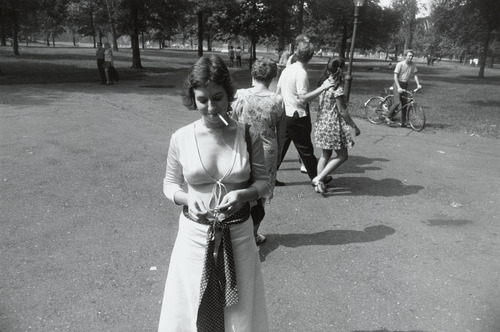
One well known image from that portfolio is this one….


At first it may seem innocent enough, true to the style of ‘street photography’

it has its language of the snapshot aesthetic in place. But like with many photographs, upon a closer inspection one begins to decipher as to how and why it must have been created which at times unravel the persona and personality of the image’s creator. 


We see a young woman, crossing a street and walking directly towards us. The image is taken not from a face-to-face level but rather from a higher level looking slightly down at her and establishing a unconscious hierarchy and control over the subject from the photographer/viewer point of view. She appears diminutive because of this and despite her (nervous?) smile, her body language suggests she is not comfortable at being photographed. 


It is written that Winogrand was not a shy person to say the least (nor do I think you can be in order to be a successful street photographer) but rather bearish in person and somewhat egotistical in personality. Although the subject is not looking at the camera, we know that given the way this image was taken, she had to be very much aware of the photographer's presence. Yet we must conclude that this image was taken without her permission, if she had agreed to be photographed in this candid form one would guess she would at least look into the lens. 

Her averting gaze suggests otherwise. Now if this were the only case, one can overlook this intrusion, but perusing through his book, one encounters this dynamic over and over again.

For example, in the following three images, the subject still had to be aware they were going to be photographed (This was at a time after all, when people actually looked at where they were going and not at their smart phones) considering the photographer would have been directly in front of them with a camera held up to his eye.


And again the averted gaze speaks volumes.

But lets give this all the benefit of the doubt and say that the subject at hand did not notice the photographer and therefore was not using their averted gaze to dissuade the photographer from taking their picture, afterall there are many instances that the subject isn't truly aware of the camera.

So then lets asks ourselves, what is his intent with this images under the context of 'women are beautiful'?


Is it me, or do you also see a reoccurring theme front and center?
Even when the subject shares equal status with a male counterpart (as in the one directly above), the focus of the light does not make the intent ambiguous.

And just in case, we think Winogrand is simply trying to just show women as beautiful and independent creatures, we come across these images....


The focus is not apparently on ALL women and their individual beauty but rather on the younger sexualized woman in the group. Winogrand's composition in putting the main subject front and center exposes his intent.

Now, I really do not know what was the critical response to this book when it came out, but I can assure you that no photography program in this country today would allow this work to develop as it did. Not only it is narrow and limited in its subject scope and investigation, it can also be critiqued (in my opinion) as racist and ageist besides blatantly sexist. There is hardly any evidence of the ‘subject’ diverting from being young, white and objectified sexually.

To think that he is known as a "portraying the social issues of his time" seems like an overstatement (or perhaps I am viewing these with contemporary eyes). This is America in the early 1970’s. Where is the evidence of the female empowerment taking place? Can it be simply demonstrated in the women's style of dress? Where is the racial and cultural diversity? You would be hard pressed to find a proportional amount of African-americans or Hispanics in relation to caucasians in the book. In New York City of all places! 

I have to wonder if this is just one of the many cases in history in which notoriety trumped reality? Was this accepted because Winogrand had the support of academia? (he was gifted the prestigious Guggenheim several times) and by the time he produced these images he had already established himself. Or is it simply an accepted norm and oversight of the times? Again, it is not to say that he didn’t create images that belong in the canon of photographic history but in my book his name comes with an asterisk.

1.31.2014

Portrait work by Avedon

Okay, One more entry on Richard Avedon before its seems like I'm president of his fan club.

Like I mentioned earlier, Avedon was a successful fashion / commercial photographer but wanted to be considered an 'art' photographer as well. So besides doing beautiful images of beautiful people wearing beautiful clothes, he also concentrated on making strong compelling portraits of famous people as a means to earn a certain kind of respect in that field (An interesting side note: his equally successful contemporary in the fashion photography world, Irving Penn, chose the genre of the still life instead).
Avedon's quest led him to take on an ambitious project when he traveled through the western United States and photographed regular people that caught his attention, this work culminated in an exhibition and book titled 'In the American West'. Both the book and exhibition were successful commercially and critically although it has been critically panned as well (more on why below) and helped further establish him as a household name.

Probably to differentiate his portrait work from his fashion work, Richard Avedon is known to have established a particular mode operandi to get the image that he wanted from his subject.

The Duke and Duchess of Windsor, Waldorf Astoria, suite 28A, New York, April 16, 1957


The story goes that for the image above, Richard Avedon was telling the Duke and Duchess of an incident in which he saw a dog being hit by a car while he was heading over to the shoot. Knowing that the Duke and Duchess were avid dog-lovers, he was expecting them to have an adverse reaction to the story, making them lower their guard (the one everyone puts up when they know they are being photographed) and capture them with this look. What comes through is not one that contains the shield of a smile but one that is more raw and realistic and exposes the inner self.

Marilyn Monroe, actor, New York, May 6, 1957
We can assume that a similar thing happened here.  This is not the Marilyn Monroe persona Ms. Baker tried so hard to foster, but one in which shows her vulnerability as much as her cleavage. Gone is the tilted head thrown back with slightly opened lips and lowered eyelids that Ms. Baker used to suggest as a post-coitally satiated presence, instead we see her with slumped shoulders and lost in introspection. She appears diminutive and overpowered by the emptiness around her.

Maria Callas, coloratura soprano, New York, February 10, 1970
And here is Maria Callas. The look on her face does not feel like it comes from acting but rather from hurt and candor.

Don't get me wrong, I think these are wonderful images, some of my favorite actually, but I just can't help but wonder what the subject's reaction was to them. Here is a person about to be photographed by a photographer who makes utterly beautiful images working with the most beautiful models of the time and he makes you look sad and pitiful.  I can't imagine Monroe being happy with her image depicting her like that during the height of her fame, nor the Duchess of Windsor content with her depiction showing all the wrinkles of time and tears written across her face.

Avedon is definitely not the only photographer to resort to 'tricks' to get the portrait they want, and you have to do what you have to do to get the image you want to get.  Many portrait photographers use 'tricks' to get their subjects to relax or at least put down their guard. Some even resort to not even putting film in the camera during the first 'rolls' of shooting. These first 'rolls' of shooting exhausts the subject and allows the best images to be created during the final rolls when the subject has lost their self-consciousness.

But it was this 'rawness' which created most of the critique directed at what is perhaps his magnus opus 'In the American West.' For this ambitious project, Avedon photographed thousands of images using several assistants, an 8X10 large format camera with his signature white backdrop and had them printed larger-than-life for exhibition purposes.

Hansel Nicholas Burum, coal miner, Somerset, Colorado, December 17, 1979


He abandoned photographing celebrities and models and instead concentrated on everyday working class people as his subject and the critique comes because of this.

Juan Patricio Lobato, Carney, Rocky Ford, Colorado, August 23. 1980

Here is a well-established fashion photographer, who has worked with some of the most famous people of the time, comes in with a crew, lighting and an 8X10 camera (which can be very intimidating) and sets up a background which strips a person of their surroundings (and therefore some identity) to photograph people who are not in the habit of being photographed at this level. 

Needless to say, the structure of power is all in the hands of the photographer and the process can, and has been, seen as exploitative. The blank background (and large scale) encourages the viewer to scrutinize the subject being depicted.

Some would argue that this is also how Avedon depicted celebrities, but we must consider for a moment how one views the images of the rich and famous being depicted as vulnerable, it somehow humanizes their stature, as opposed to viewing someone of lesser means depicted in the same manner, it instead opens them up to pity.

Petra Alvarado, on her birthday, factory worker, El Paso, Texas, April 22, 1982

7.08.2013

One HOT Pepper!


Pepper, #30, 1930 by Edward Weston, Gelatin Silver Print


This image is one of a series of peppers made by Edward Weston. It is considered to be one of the early 20th century photographic masterpieces by one of the most innovative photographers. It also happens to be one of the most expensive images ever sold.

Regardless of this, it is one of my favorite images for several reasons, all of which make a strong argument as to why photography is such a great art-making medium. 

First, it proves that you don't need a special event or happening to make a compelling image, through photographic means this ordinary object is transformed into something extra-ordinary thereby affirming that anything can be seen as art. 

Weston used light and composition to convert a recognizable object into one that is abstract and suggestive. His use of a tight crop and low vantage point not only isolates the object but allows the scale of the object to be brought into question despite our better understanding of it. This makes this iconic image to become not just one of a pepper but one that allows the mind to wander. Similar to our natural tendency to see recognizable shapes in amorphous clouds, the soft tonal rendering of the organic shape takes on a sensual identity and transforms the vegetable into a seemingly human form. 

In doing so, Weston underscores the transcending power of photography and helped establish the medium's relationship to Modernism and art.

7.07.2013

Garry Winogrand

Garry Winogrand is considered one of the masters of street photography from the late 20th century. His career was forged by John Szarkowski during his tenure as Director of the Photography Department at MoMA and it culminated in establishing Winogrand's place in photographic history. 


Winogrand is the author of many great images that give us a candid glimpse of the American social landscape of the 60s and 70s. This is partly due to the fact that he was extremely prolific.  At the time of his death he left thousands of undeveloped rolls of film along with even more developed but unedited ones.


Garry Winogrand, New York World's Fair, 1964; gelatin silver print

The image above, New York World's Fair, 1964, is perhaps one of his better known images. 


It is said that Winogrand depicted the social issues of his time, so the date the image was made is extremely important since it informs its content. At first glance, the image is a visual play of body language with a tightly cropped composition and strong diagonal horizon accentuated by a slight tilt of the camera. But the year it was taken places it during the early years of the Civil Rights Movement and thus gives the image an added interpretation.


On the left side of the image, we see an African-American man in conversation with a Caucasian woman. Directly next to them sit three young women engaged in a secretive conversation, what they discuss is left for speculation, however they do take on a comic nod to the classic see/hear/and speak no evil gestures.

Following them is two more young women drastically turning away looking towards the distance and finally the image is book-ended by an older white male reading the newspaper and almost outside the frame. 


What is most interesting to me is Winogrand's composition. As a street photographer, you have little if no control of your subject's actions, you must simply compose and capture the right moment at the right place from the right point of view (not an easy feat and one that distinguishes the success of good photo-journalists). Although Winogrand is shooting from the side which already gives him the diagonal nature of the horizon line, he also (purposefully?) tilted the camera. This simple gesture creates a sea-saw effect of sorts with the overly-crowded park bench and one in which can denote some social upheaval. Given Winogrand's sophistication in shooting, I would assume the depiction of a young generation in constant motion and unrest as they literally push a stand-in for the older white patriarchal establishment out of the frame, is no accident. 


The loaded question is whether Winogrand was celebrating, critiquing or simply overemphasizing the reading. If the image would have been directly shot at a level this reading would not be as clear, chances are the focus would have been mostly on the three huddled women at center. The question only arises with the use of the camera tilt, what it suggests and what the photographer was trying to communicate by doing so.

6.24.2013

Dovima with elephants by Avedon

And speaking about images I have a hard time deciding which to like best (see Little Joe both clothed and nude in previous entry), there are two images in existence of Dovima with Elephants, both shot by Richard Avedon during the same photo shoot.

Dovima was a 1950's 'supermodel' who pre-dated the term by about 10 years. She was perhaps a muse for Avedon and for many other photographers considering she is the model to some of the best fashion photography of the time.  Avedon made his mark as a fashion photographer by incorporating movement in the genre when the standard was to shoot stiff and posed models.

You can only imagine that in order for the images below to exist as they do, the model had to be attune and quick to the movements of the otherwise uncontrollable props (in this case, the elephants).

Dovima with elephants, evening dress by Dior, August 1955, by Richard Avedon

In this great image above, Dovima's arched arm mimics the curved trunks of the elephants beside her. Her white and black Dior dress looking impeccable and contrasting with the otherwise general grayness of her surroundings.

And in the bottom one, she appears to be leading a band of elephants (her perfectly placed left foot front and center) while taming their charge with her delicately positioned hands.

Dovima with elephants, evening dress by Dior, August 1955, by Richard Avedon
Again not a simple feat for either model nor photographer considering how quick they both had to be to capture the right moment.

And to add difficulty to the mix, Avedon is working with a large format camera which slows down the shooting process, there is no quick and rapid succession of shooting as with smaller format cameras using roll film.

We can tell what format Avedon is using here because of the black border around the images. The black borders come into play when the unexposed edges of the film are included in the printing and although this can be done with any format, the markings of these borders (notice it doesn't go all the way around the image) is evidence of the film holder edges one uses when shooting sheet film in large format photography.

The only visible difference in the achievement of these images is that because of the borders, we also know the bottom images is full-frame while the top image has been cropped from the top (the proportion is also not exactly in sync with the sheet film's size).

Yet both remain a testament to Avedon's talent (and Dovima's), I am sure I'm not the only one who can't choose which one is better between the two, it is no wonder they are both considered the iconic images that they are.

6.21.2013

Portraits by Avedon

Another prized-possession of mine is this 'Portraits' portfolio by Richard Avedon.


I had become aware of Avedon's fashion photography work when I would browse through magazines. Avedon was still doing the covers for Vogue and was recognized for his early fashion work from the 50s in many photography books.

But one of the two things that make this book so special to me is how I found it. It was in the bottom shelf of a sales book rack in the Fort Lauderdale Main Public Library and cost $2! Yes, just TWO BUCKS!! It was in the mid-80s and I would normally have no money to buy anything, but this book was extremely affordable on my budget.

And the second reason (as if a great bargain wasn't enough) is that the book contains one of  his multi-panel spreads of Andy Warhol with some of his factory members.


And more specifically with 'Little Joe' rendered both clothed and in the nude, perpetually making me unable to decide which one I think he looks better in. The image of him in the left panel, hair pulled back and posed in classical greek sculptural glory...or dressed in all black and boots, hair loose, looking like the urban bohemian his demeanor exudes.
(needless to say, I've had a very long fascination with Joe Dellasandro's image.)

The images from the book were part of an exhibition and it was perhaps one of the first instances photographic images were printed this large in the pre-digital age.

I believe these images are from 2012 exhibition but Avedon (or at least his assistants) were printing  these gelatin-silver photographs in a traditional b&w wet darkroom in the mid-70s.


Avedon probably did this scale for several reasons and one of them was probably to create attention and overcompensate for photography's diminutive status in the art world during the 70s.

Just like Warhol, Avedon was very successful in the 'commercial' field at a time when it was rigidly separated from the world of 'fine art'.  He, like Warhol, wanted his work to be taken seriously, so he set out to make his portrait work. He received validation by being one of the first photographers ever given a solo show in a major museum outside photography-designated galleries.

Perhaps as a way to elevate these photographs in the context of 'fine art' he pushed their limits by executing them to the largest size possible at the time. There is no denying these prints deserve a certain kind of respectability and awe merely because of size and execution. But he also emphasized the image's minimalist language by creating a sense of empty space with use of scale.

Little Joe


Duane Michals -- Joe Dallesandro as Gargoyle

chance meeting -- duane michals

Here's a photographic sequence by Duane Michals.
One of the reasons I enjoy his work so much is not only for its uniqueness in execution (his use of hand-written text and sequential images sets him apart) but for the subject matter and narratives he explores.


When I first came across this image, I was immediately drawn to the suggestive undertones the 'chance' meeting holds. 
And a frustrated encounter to boot.

6.15.2013

Duane Michals


This is the work of Duane Michals. He is the first ‘art photographer’ I was introduced to at a time when I thought photography was either a document or simply vernacular. I had no idea that it could be an expression of something or even tell a story. He was introduced to me in my second year of college by a professor whose name I can’t recall and at a time when I was working in ceramics, frustrated and looking for a means to creatively execute my thoughts and ideas. One of our assignments in this beginning photography class, was to emulate Michals, and I did so by using a slow shutter speed to capture motion and using multiple images to create a simple narrative. Of course, it was deemed successful at the time mostly due to the technique and good execution, however when I look back at them now, I see the naiveness of a student who is new to the medium. 

Even though I now know of many photographers I like and find inspiring, Duane Michals is still a photographer whose work I love and admire. His choice of male models at times are a little too-perfect for my taste (some look like adult cherubs), but the way he works and the fact that he uses hand-written text right on the print still feels different and distinguishable from the many photographers out there. Part of my attraction to his work I suppose has to do with our shared affinity in sexual orientation, but years later when I came across an interview with him, I realized we also shared a fascination with death. He, like me, have always been obsessed with the idea of death and mortality since an early age. However he, unlike me, recognized early on in his career that the themes of loss, desire and longing are always ripe for investigation.


One of my favorite possessions is this small out-of-print book I came across in the 80s. It has Michals’ photographic interpretations of the poems of Constantine Cavafy. Michals visual eroticism paired alongside Cavafy’s poems of nostalgic longing and unrequited love with The Smiths playing continually on my record player is what composed most (if not all) of the angst that was my twenties.


                                                                                    ---Duane Michals


Understanding

My younger days, my sensual life ---
how clearly I see their meaning now.

What needless, futile regret....

But I didn't see the meaning of it then.

In the loose living of my early years
the impulses of my poetry were shaped,
the boundaries of my art were plotted.

That's why the regretting was so fickle.
Any my resolutions to hold back, to change,
lasted two weeks at the most.

                                                                        ---Constantine Cavafy