Showing posts with label reviews. Show all posts

6.07.2014

Brokeback Mountain

I wrote the following review in October 2007 for the movie Brokeback Mountain on Netflix as a response to reviews I was reading from viewers. I felt that some of those reviewers were missing the crux of the movie and some were bordering on homophobia. This was my response to them.


I found this movie to be a cinematic masterpiece and one whose style and content many reviewers in here (Netflix) may have missed the basis of. This movie goes beyond being a 'gay' movie into a movie that is collective in scope and leaves us with something to learn and take away from. In regards to the slow pace of the movie as some have complained, I think that it is was being purposefully used. The slow panning of the landscape not only depicts the sublime and expansive landscape but also helps to magnify the banality and mundaneness of small rural mid-western towns and Ennis' life in particular. The director Ang Lee, uses a similar tactic in the movie Ice Storm to create a palpable chill depicted through the weather and through the detachment of the characters' lives). Brokeback Mountain is not an 'agenda movie' trying to validate the deceit and actions of these men as some have suggested but rather to serve as evidence and reminder that living a double life is harmful not only to those you deceived but to those that do the deception as well. The women in this story are as much a victim of the rigid social conformity prevalent during that time as the men are. They are afflicted by the betrayal the men are consigned to create. 

This movie does not have a happy Hollywood ending nor can this story be sugar-coated. It instead leaves us with no consolation or resolution and makes us feel the regret and frustration of understanding oneself only when its too late. Unfortunately history is seen with 20/20 hindsight vision and in this post-Will and Grace society in which same-sex lifestyles are much more visible and tolerated than it ever has been, it is hard for us to situate ourselves at a time and place when gay men (and lesbians) had no role models nor narratives in which to live their lives by. This movie gives us an understanding of the actions of individuals during a time when their desire (homosexuality) was considered a pathological disease, their acceptance ('coming out') was a social death sentence, and their love (universal and whole) was riddled with guilt. These men and many like them were resigned into living their entire lives either denying their desires or fulfilling them in the dark shadows of shame.

6.03.2014

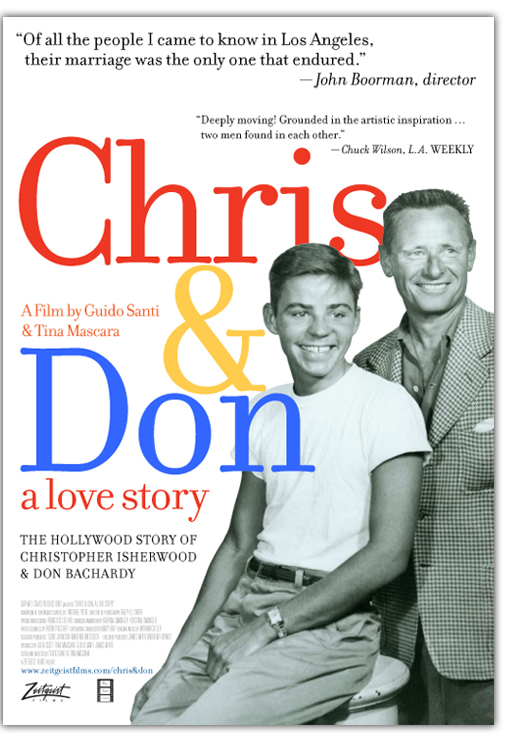
Chris & Don: A Love Story (2007)

A touching and inspiring story of enduring love and same-sex relationship involving the writer Christopher Isherwood and his partner Don Bachardy. 

The strength of this movie comes from actual photos and extensive footage from home movies and not so much on staged re-enactments that usually pepper documentaries of this nature. These home movies serve as a testament to a strong and happy (and controversial) relationship displayed alongside some of Hollywood and literary greats of the time. Both men are talented in their own right but the movie's true inspiration comes from seeing their courageous 30-year plus relationship lived out in the open during closeted times, and it is Don's actions and motivation during Christopher's death that expresses the true depth of their spiritual and emotional bond. 

Don Bachardy painting a life portrait of his partner Christopher Isherwood

However, it is hard to overlook the circumstances that might have contributed to the success of their love (and to its controversy). Their May-December relationship is disturbing when one realizes just how young Don was when he started dating Christopher and the effect this might have had on Don's own sense of self-worth and identity. This not only comes to the surface when Don admits to emulating Chris's mannerisms and speech but also in his admission to his constant need of approval from Christopher in even deciding what to wear. The fact that Christopher (through his writing) professes to be attracted only to those outside (and beneath) his blue-blood social class taints this relationship with an air of manipulation. Which is unfortunate, because what could be seen as a successful and validating gay relationship during times of adversity at times becomes tarred by seeming as subjugated love. 

Review originally written on 4/2/10

9.17.2013

Book review: Porn from Andy Warhol to Xtube

The other day I did something that I hope other people do as well; I googled myself to see what comes up. To my surprise, up there in the search results was a review I wrote in Amazon.com in April, 2011. It turns out the review is one of the most read reviews for that book in particular and one who most customers found helpful. I decided to include it here for posterity's sake with a few edits.

A vintage image from the early years of modern day porn,
unfortunately the book doesn't contain that many more.


Great on Style, Weak on Substance (2 out of 5 stars)
If it wasn't for the title denoting something more than a vanity project for studio-produced porn stars I would not be as 
This book is filled with beautifully printed full-page photographs depicting some of the better-known porn stars of the past 30-odd years, however if you are interested in a book whose title suggests to be ABOUT porn rather than a book OF porn, you will be left disappointed. This is far from a pictorial investigation or a truly historical account of male erotica, it relies too much on the obvious and popular porn stars of the 90s and hardly illustrates more important images from the earlier period as the book's cover suggests. The book is divided categorically with certain eras of the genre, but it is far from being developed analytically. Case in point is how the anemic amount of text (which is really half of what it appears to be since the other half is simply its German translation) is saved for interviews of distinguished directors in the field, yet the questions directed to them are equivalent to "Who is your favorite porn star?" causing it to read more as a superfluous magazine interview than anything else.

From the book's front flap and throughout, the author and his sources repeatedly cite porn as being reflective of society it was produced, yet no one bothers to extrapolate how or why this may be the case. Yes, we know that the mustachioed hairy-chested macho man of the seventies gave way to the smooth athletic jock of the eighties, but was this a reflection of the cultural shift of the decade or a reaction to the rise of AIDS? It would have been interesting to note for example, the first film to incorporate safe sex (considering how the gay  porn industry led the way in promoting it more than any government agency) or maybe investigating whether porn's mimetic use of popular Hollywood movies (i.e. Saving Ryan's Privates) is an act of subversion or an attempt at inclusion (porn movie plot lines and fantasy is never addressed by the way)? Instead the author glazes over interesting observations and concentrates too much on his biased interpretation. For example, he includes Tom Bianchi's work in the mix. Everyone can agree that Bianchi's photographs are beautifully executed manifestations of male desire, but would one call it pornographic? And if we are to use that broad description wouldn't we also need to look at his equally important and successful contemporaries such as Christopher Makos, Herb Ritts and Bruce Weber. Isn't Weber's image of the Olympic athlete just wearing a pair of white Calvin Klein briefs towering over Times Square an important breakthrough of male erotic objectification into mainstream culture, certainly more so than Bianchi. Or even Robert Mapplethorpe, whose controversial work was important in contributing to the discourse between art and porn.


Of course, I am the first to admit that while perusing through this book and its images, the furthest thing from my mind was wondering what lies behind the popularity and demand of certain porn stars (is it aggressive marketing or synchronistic desire?). However, considering there is a unified voice in this book in depicting the subject as culturally relevant, one is simply left to wonder whether porn is imitating life or is life imitating porn? Perhaps pornography may forever be relegated to its intended goal but considering how it has been the only true narrative for gay men, it would be nice to see someone attempt to treat it as a source of collective self-reflection rather than a glorified skin mag.