6.14.2014

Naked Fame

Originally reviewed in March of 2010, I rated this movie 2 out of 5 stars.


I don't know whether you need to be familiar with the subject to this unstructured documentary to be remotely interested. On the one hand, you might have to be a fan of his work to be invested but on the other hand watching the protagonist behave like a spoiled brat might destroy any attraction to the persona you previously had. Regardless, this documentary ends up becoming not so much a study on someone but rather more an observation on a self-obsessive culture. It appears that despite a loving relationship and a supportive family we still are unfulfilled without fame. 

Peter, a 'former' porn star known as Colton Ford and his partner, another former porn star, are very likable guys who want to leave the adult film industry and follow their dreams of becoming a singer and actor respectively. Problem is those careers are within the shadow of the Hollywood lifestyle the porn industry emulates. They seek a whole new world far away from what they have done in the past but don't go beyond their backyard to find it. One example is Colton's choice for a manager. He hires another former-porn star who is all too obviously on something (my guess is its the 'legal' speed he keeps offering everyone) and continuously ignores the neon sign over his manager's head that reads 'train wreck approaching'. 

Yet despite any talent, Colton seems to purposely situate himself on a losing battle to be the kind of singing sensation he wants to be. For one, he concentrates only on club/dance music which is dominated by female vocalists, secondly, he is in his late 30s and wants to market himself to a young early 20s crowd, and finally, he keeps one foot in the door to his previous and highly stigmatized career even though he no longer wants to be associated with it. You can't help but begin to wonder whether his desire to be a singer is just a whim or an actual passion and not just a vacuous reason to be admired. Midpoint through this documentary, despite being sympathetic to his challenges, you want to slap him senselessly (and not in the porn film sort of way) when he continually whines and complains as to why his singing career isn't going anywhere. 
Yes, because if you want to be taken seriously as a singer and not viewed as the porn star you once were,
be sure to play up your physique.

Perhaps he should concentrate on the MUSIC! Colton seems to work out in the gym more than on his vocal skills and nowhere in the documentary does it show him sitting down and concentrating on writing a lyric or two or even crafting his artistic stage persona (and from the likes of his performances here this is painfully evident). Instead he frets before a performance about which shirt he should wear (neither choice would have made a difference). Unfortunately he also suffers from tackyitis... he wears his casual street clothes onstage and relies on the ubiquitous and outdated dance moves of the mid-90s. Its going to be hard to be seen as a 'star' when your target audience dresses and dances better than you do. My unsolicited advice to him would be that if you want to stand out in any field you must first start by thinking outside the box. 

6.07.2014

Brokeback Mountain

I wrote the following review in October 2007 for the movie Brokeback Mountain on Netflix as a response to reviews I was reading from viewers. I felt that some of those reviewers were missing the crux of the movie and some were bordering on homophobia. This was my response to them.


I found this movie to be a cinematic masterpiece and one whose style and content many reviewers in here (Netflix) may have missed the basis of. This movie goes beyond being a 'gay' movie into a movie that is collective in scope and leaves us with something to learn and take away from. In regards to the slow pace of the movie as some have complained, I think that it is was being purposefully used. The slow panning of the landscape not only depicts the sublime and expansive landscape but also helps to magnify the banality and mundaneness of small rural mid-western towns and Ennis' life in particular. The director Ang Lee, uses a similar tactic in the movie Ice Storm to create a palpable chill depicted through the weather and through the detachment of the characters' lives). Brokeback Mountain is not an 'agenda movie' trying to validate the deceit and actions of these men as some have suggested but rather to serve as evidence and reminder that living a double life is harmful not only to those you deceived but to those that do the deception as well. The women in this story are as much a victim of the rigid social conformity prevalent during that time as the men are. They are afflicted by the betrayal the men are consigned to create. 

This movie does not have a happy Hollywood ending nor can this story be sugar-coated. It instead leaves us with no consolation or resolution and makes us feel the regret and frustration of understanding oneself only when its too late. Unfortunately history is seen with 20/20 hindsight vision and in this post-Will and Grace society in which same-sex lifestyles are much more visible and tolerated than it ever has been, it is hard for us to situate ourselves at a time and place when gay men (and lesbians) had no role models nor narratives in which to live their lives by. This movie gives us an understanding of the actions of individuals during a time when their desire (homosexuality) was considered a pathological disease, their acceptance ('coming out') was a social death sentence, and their love (universal and whole) was riddled with guilt. These men and many like them were resigned into living their entire lives either denying their desires or fulfilling them in the dark shadows of shame.

6.03.2014

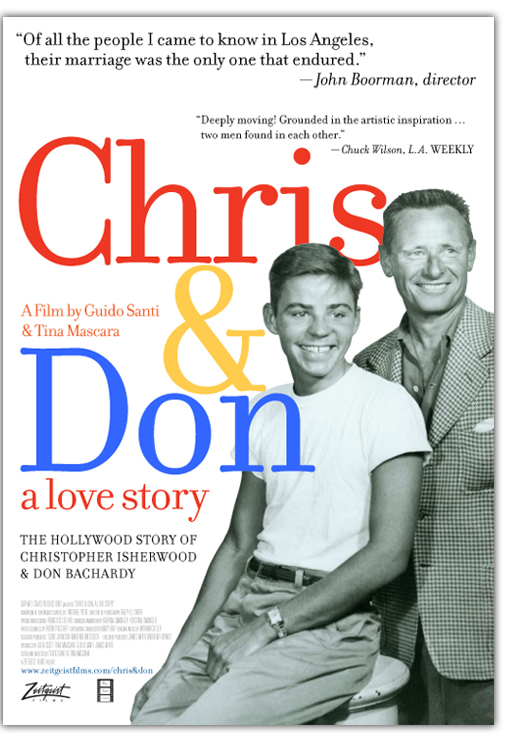
Chris & Don: A Love Story (2007)

A touching and inspiring story of enduring love and same-sex relationship involving the writer Christopher Isherwood and his partner Don Bachardy. 

The strength of this movie comes from actual photos and extensive footage from home movies and not so much on staged re-enactments that usually pepper documentaries of this nature. These home movies serve as a testament to a strong and happy (and controversial) relationship displayed alongside some of Hollywood and literary greats of the time. Both men are talented in their own right but the movie's true inspiration comes from seeing their courageous 30-year plus relationship lived out in the open during closeted times, and it is Don's actions and motivation during Christopher's death that expresses the true depth of their spiritual and emotional bond. 

Don Bachardy painting a life portrait of his partner Christopher Isherwood

However, it is hard to overlook the circumstances that might have contributed to the success of their love (and to its controversy). Their May-December relationship is disturbing when one realizes just how young Don was when he started dating Christopher and the effect this might have had on Don's own sense of self-worth and identity. This not only comes to the surface when Don admits to emulating Chris's mannerisms and speech but also in his admission to his constant need of approval from Christopher in even deciding what to wear. The fact that Christopher (through his writing) professes to be attracted only to those outside (and beneath) his blue-blood social class taints this relationship with an air of manipulation. Which is unfortunate, because what could be seen as a successful and validating gay relationship during times of adversity at times becomes tarred by seeming as subjugated love. 

Review originally written on 4/2/10

6.01.2014

The month of June

June is national LGBT history month in the United States. This is usually designated annually by the President of the United States, so has been the case under the Obama administration and the Clinton administration before that, it was not designated as such during the G.W. Bush administration for obvious reasons.

The reason June is LGBT history month is because it commemorates the Stone Wall Riots which sparked the gay rights movement in this country and around the world. The Stone Wall Riots came about when patrons (mostly transvestites) of the Stone Wall Inn, a small bar on Christopher Street in the West Village of New York City, got fed up of the systematic and targeted police harassment and arrests and began a spontaneous retaliation that lasted a couple of nights. The 'riot' was not necessarily very destructive but was instrumental in bringing about the gay (LGBT) rights movement unto the national discourse which lasts still to this day.   

This is also why June is the month when most Pride parades take place in many cities in the country and in many countries around the world culminating in the one celebrated in NYC in the last Sunday of the month. Of course, as with everything, history gets lost in the generations that don't live through it, which is mostly why Pride parades are no longer the political demonstrations they started as and are more the jubilant activities they are today.

An interesting side-note, it is theorized that the reason the patrons where particularly intolerant of the police harassment on the fateful evening was because it was the day in which Judy Garland was laid to rest. Many patrons had supposedly gone to the bar to mourn and memorialize her. Judy Garland, was from no doing of her own, a gay iconic figure because many sympathized with her tumultuous life of continually being used and abused by lovers and producers alike. Her best known song 'Over the Rainbow' became the de facto anthem of longing for a place of acceptance to live ones happy life....somewhere (and someday)! 

The song is sometimes credited for the formation of the 'Rainbow' flag becoming the symbol for the movement. However, the person who designs it doesn't necessarily agree instead insists that the colors are representative of the diversity and scope of the beneficiaries of the movement. 

Anyway, in celebration of June of this year for no reason in particular, I will be re-posting reviews I have written in Netflix and blogs everywhere of movies whose characters, plots and or protagonists are of the LGBT community (mostly 'gay' and not always in a good light).

2.28.2014

Massachusetts Cultural Council Photography Show at the New Art Center


A photographic exhibition featuring the works of some of the fellows and finalists of the Massachusetts Cultural Council 2013.

2.04.2014

Personalities, A Portrait Show at SMFA gallery in Portland, Maine


This show came out of nowhere, I was contacted by Susan Maasch about including my series 'Guys and Dolls' with her group exhibition, Personalities.  I submitted twelve framed images which were exhibited in a grid form, alternating between G.I. Joes and Ken dolls.

The best part about being included in this show was traveling to Portland via train and staying overnight at Karen and Katherine's house.

1.31.2014

Portrait work by Avedon

Okay, One more entry on Richard Avedon before its seems like I'm president of his fan club.

Like I mentioned earlier, Avedon was a successful fashion / commercial photographer but wanted to be considered an 'art' photographer as well. So besides doing beautiful images of beautiful people wearing beautiful clothes, he also concentrated on making strong compelling portraits of famous people as a means to earn a certain kind of respect in that field (An interesting side note: his equally successful contemporary in the fashion photography world, Irving Penn, chose the genre of the still life instead).
Avedon's quest led him to take on an ambitious project when he traveled through the western United States and photographed regular people that caught his attention, this work culminated in an exhibition and book titled 'In the American West'. Both the book and exhibition were successful commercially and critically although it has been critically panned as well (more on why below) and helped further establish him as a household name.

Probably to differentiate his portrait work from his fashion work, Richard Avedon is known to have established a particular mode operandi to get the image that he wanted from his subject.

The Duke and Duchess of Windsor, Waldorf Astoria, suite 28A, New York, April 16, 1957


The story goes that for the image above, Richard Avedon was telling the Duke and Duchess of an incident in which he saw a dog being hit by a car while he was heading over to the shoot. Knowing that the Duke and Duchess were avid dog-lovers, he was expecting them to have an adverse reaction to the story, making them lower their guard (the one everyone puts up when they know they are being photographed) and capture them with this look. What comes through is not one that contains the shield of a smile but one that is more raw and realistic and exposes the inner self.

Marilyn Monroe, actor, New York, May 6, 1957
We can assume that a similar thing happened here.  This is not the Marilyn Monroe persona Ms. Baker tried so hard to foster, but one in which shows her vulnerability as much as her cleavage. Gone is the tilted head thrown back with slightly opened lips and lowered eyelids that Ms. Baker used to suggest as a post-coitally satiated presence, instead we see her with slumped shoulders and lost in introspection. She appears diminutive and overpowered by the emptiness around her.

Maria Callas, coloratura soprano, New York, February 10, 1970
And here is Maria Callas. The look on her face does not feel like it comes from acting but rather from hurt and candor.

Don't get me wrong, I think these are wonderful images, some of my favorite actually, but I just can't help but wonder what the subject's reaction was to them. Here is a person about to be photographed by a photographer who makes utterly beautiful images working with the most beautiful models of the time and he makes you look sad and pitiful.  I can't imagine Monroe being happy with her image depicting her like that during the height of her fame, nor the Duchess of Windsor content with her depiction showing all the wrinkles of time and tears written across her face.

Avedon is definitely not the only photographer to resort to 'tricks' to get the portrait they want, and you have to do what you have to do to get the image you want to get.  Many portrait photographers use 'tricks' to get their subjects to relax or at least put down their guard. Some even resort to not even putting film in the camera during the first 'rolls' of shooting. These first 'rolls' of shooting exhausts the subject and allows the best images to be created during the final rolls when the subject has lost their self-consciousness.

But it was this 'rawness' which created most of the critique directed at what is perhaps his magnus opus 'In the American West.' For this ambitious project, Avedon photographed thousands of images using several assistants, an 8X10 large format camera with his signature white backdrop and had them printed larger-than-life for exhibition purposes.

Hansel Nicholas Burum, coal miner, Somerset, Colorado, December 17, 1979


He abandoned photographing celebrities and models and instead concentrated on everyday working class people as his subject and the critique comes because of this.

Juan Patricio Lobato, Carney, Rocky Ford, Colorado, August 23. 1980

Here is a well-established fashion photographer, who has worked with some of the most famous people of the time, comes in with a crew, lighting and an 8X10 camera (which can be very intimidating) and sets up a background which strips a person of their surroundings (and therefore some identity) to photograph people who are not in the habit of being photographed at this level. 

Needless to say, the structure of power is all in the hands of the photographer and the process can, and has been, seen as exploitative. The blank background (and large scale) encourages the viewer to scrutinize the subject being depicted.

Some would argue that this is also how Avedon depicted celebrities, but we must consider for a moment how one views the images of the rich and famous being depicted as vulnerable, it somehow humanizes their stature, as opposed to viewing someone of lesser means depicted in the same manner, it instead opens them up to pity.

Petra Alvarado, on her birthday, factory worker, El Paso, Texas, April 22, 1982